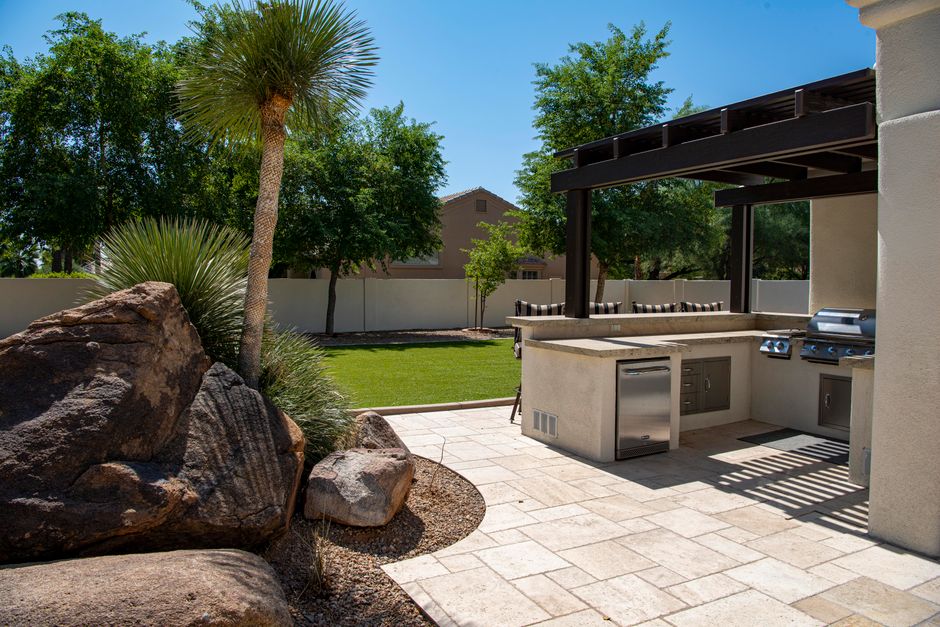
Pavers are the better long-term choice for most Riverside backyards, because our expansive clay soils move with the seasons and a paver field flexes with that movement instead of cracking. Poured concrete is the right call when you want a large, uninterrupted, low-cost surface—a side yard, an RV pad, a utility slab—and you can accept that it will crack somewhere in the first five years.
That's the answer. Now the reasoning, because the two materials fail in very different ways, and knowing how each one fails is what makes a materials decision hold up ten years out.
What each one actually costs to install
Nationally, standard broom-finish concrete runs roughly $8 to $15 per square foot installed. Stamped or colored concrete pushes that to about $14 to $25. Interlocking concrete pavers typically land between $16 and $30 per square foot installed, with natural stone and porcelain pavers higher still.
On a 400-square-foot patio, that's a real gap: somewhere around $4,000 to $6,000 for plain concrete versus $7,000 to $12,000 for pavers. Anyone quoting well under those ranges is either skipping excavation, skipping base, or skipping both.
What moves the number most isn't the surface material. It's site work. Demolition and haul-off of an existing slab adds $2 to $6 per square foot. Grade changes, retaining, or a drainage line to daylight add more. If the patio ties into a patio cover, an outdoor kitchen, or a fireplace footing, those footings have to be poured and inspected before the surface goes down, and sequencing that correctly costs money you don't see in the finished photo.
The base is the job
Most failed patios in the Inland Empire are failed base prep. Not bad pavers, not bad concrete—bad ground underneath.
A properly built paver patio starts with excavation to roughly 10 to 12 inches, then four to six inches of compacted Class II aggregate base for a pedestrian patio, more for a driveway. Compaction happens in lifts of about three inches, each one run with a plate compactor. Then a thin bedding layer of coarse sand, screeded flat, pavers set, edge restraint spiked at the perimeter, and joint sand swept in and vibrated.
Concrete has its own version. Four inches of slab on four inches of compacted base, with steel—either #3 or #4 rebar on 18-inch centers or welded wire mesh held up in the middle of the pour, not lying on the dirt. Control joints, the tooled or saw-cut grooves that tell the slab where to crack, need to be cut within about 12 to 24 hours and spaced at roughly 2 to 2.5 times the slab thickness in feet. On a four-inch slab, that's joints every 8 to 10 feet.
Riverside sits on soils that swell when wet and shrink when dry. That seasonal movement is exactly what lifts and cracks a thin, unreinforced slab poured on native ground. Money saved on excavation and compaction is money spent again later, and the second time you're also paying for demo.
Durability: how each one ages here
Concrete will crack. That isn't a defect claim, it's material behavior—concrete shrinks as it cures and moves with temperature. Good control joints direct where those cracks go. On a well-built slab you'll see hairline cracking in the joints and not much else. On a poorly jointed slab poured on soft ground, you get a random crack across the middle of the patio within two to five years, and it widens with each wet winter.
Pavers don't crack as a field, because they aren't one piece. Individual units can chip, and a section can settle, but a settled section can be pulled up, the base re-compacted, and the same pavers reset. That repairability is the single biggest practical advantage in a climate with soil movement and irrigation running eight months a year.
Sun matters too. Riverside gets around 270 sunny days and long stretches above 95 degrees. Integrally colored concrete and stamped concrete fade under that UV load—expect noticeable lightening in five to eight years unless it's resealed. Pavers are colored through the full thickness of the unit, so a chip shows the same color, and fade is far less obvious. Bare concrete also runs hot underfoot; a light-colored paver near a pool deck is meaningfully cooler than dark stamped concrete in August.
Reasonable lifespans here: 25 to 30 years for a well-built slab before it looks tired, 30 to 50 for a paver field with periodic joint sand and the occasional reset.
Maintenance, side by side
- Pavers: sweep and rinse as needed; re-sand joints with polymeric sand roughly every 5 to 10 years; reseal, if you seal at all, every 3 to 5 years; expect a few weeds at the joints and a spot reset if a section settles.
- Concrete: reseal every 2 to 3 years for stamped or colored finishes, 5 or so for broom finish; degrease oil stains promptly since they wick in; crack repair is cosmetic at best—a filled crack still reads as a filled crack; resurfacing an aging slab typically runs $3 to $7 per square foot and buys maybe another decade.
- Both: keep sprinkler heads off the surface. Hard water in the Inland Empire leaves mineral staining on concrete and efflorescence on pavers, and constant irrigation overspray at one edge is a common cause of localized settling.
Which fits which situation
Use concrete where the surface is functional and the shape is simple. Long side yards, trash-can pads, a slab under a shed, an RV parking pad. Concrete also wins where you need a very large uninterrupted area on a tight budget, or where a future addition may sit on top.
Use pavers where the space is a room. Patios you'll furnish, walkways, pool surrounds, driveways with turning traffic, and anywhere a utility line runs underneath—you can lift 20 pavers, do the work, and set them back with no seam to explain. Pavers also handle curves, borders, and grade transitions better, which matters on the sloped lots common in the hills above the 91 and around Woodcrest.
One more consideration: if a patio cover, pergola, or outdoor kitchen is in the plan, decide that before the surface goes in. Post footings should be poured first and the surface built around them. Retrofitting a footing through a finished patio is possible but it costs more and it always shows.
Before you sign anything
Get the scope in writing with base depth and compaction spelled out—"four to six inches of compacted Class II base" is a sentence a real contractor will happily put on paper. Vague scopes are where corners get cut.
Verify the license number on the California Contractors State License Board website; the lookup is free and takes a minute. Ask for a certificate of insurance sent directly from the agent, not a photocopy. California limits the down payment on a home improvement contract to $1,000 or 10 percent of the contract price, whichever is less, so a demand for half up front is a warning sign. So is a contractor who tells you a patio cover or an attached structure doesn't need a permit. In most Riverside jurisdictions, a solid-roof patio cover attached to the house does, and permitted work means an inspector looks at the footings and the ledger connection before they're covered up.
Typical timelines: a 400-square-foot paver patio runs about five to eight working days including base prep, a comparable slab about three to five days plus a seven-day cure before furniture and a 28-day cure before heavy vehicle loads. Rain delays base work more than anything else, so winter projects slip.
The decision rule
Choose concrete if the area is utilitarian, the budget is fixed and tight, the shape is rectangular, and you're comfortable with visible control joints and eventual cracking. Choose pavers if it's a space you'll sit in, if you're on expansive clay or a sloped lot, if there's a pool or irrigation nearby, or if you plan to stay in the house long enough that repairability and fade resistance are worth the extra $3,000 to $6,000 on a typical patio.
And if you're weighing a bid that's half of everyone else's, ask exactly how deep they're excavating. That answer usually settles it.